
Am I an Hourglass or Pear? Body Shape Guide
Am I an Hourglass or a Pear?
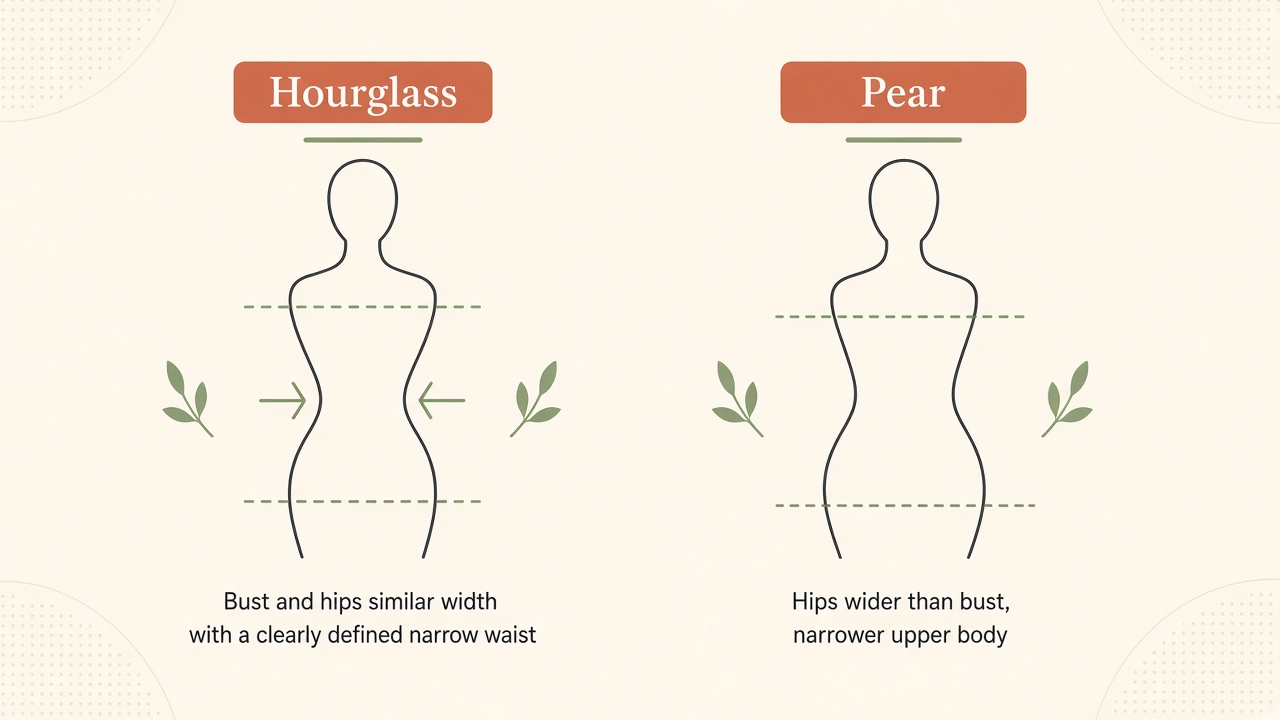
Tell an hourglass from a pear by comparing your bust and hip measurements. An hourglass has a bust and hips of similar size with a much smaller waist, so the top and bottom balance. A pear, also called a triangle, has hips noticeably wider than the bust, so the silhouette is narrower on top and fuller below. The relationship between bust and hips is the deciding difference.
Body shape describes the silhouette, the way the main girths relate, and it is a guide for clothing fit rather than a measure of health or worth. The Body Shape Calculator compares your measurements and returns the closest category. This guide explains how to read the hourglass and pear results and tell them apart.
The Key Difference: Bust Compared to Hips
The single question that separates an hourglass from a pear is whether the bust and hips are close in size. An hourglass keeps them nearly equal, so a bust of 38 inches and hips of 39 inches with a 28-inch waist reads as an hourglass. A pear widens toward the hips, so a bust of 35 inches and hips of 41 inches reads as a pear.
Both shapes often show a defined waist, which is why the waist alone does not decide the category. The comparison that matters is top to bottom: matching bust and hips point to an hourglass, while hips clearly wider than the bust point to a pear. Measuring all three girths in the same unit keeps this comparison honest, a point covered in the guide on how to measure your body shape.
How to Read an Hourglass Result
An hourglass has three features: a bust and hips of similar width, and a waist much smaller than both. The waist typically draws in by around 9 to 10 inches or more relative to the bust and hips, which creates the balanced curve on both sides. The result feels symmetrical from top to bottom.
Within the hourglass family, smaller distinctions exist. A top hourglass carries slightly more width at the bust than the hips, and a bottom hourglass carries slightly more at the hips while keeping the defined waist. These variations still count as hourglass shapes, because the waist definition and near-balance remain. The body shape types page shows each variation side by side.
How to Read a Pear Result
A pear, or triangle, has hips that are the widest part of the silhouette, with a narrower bust and shoulders. The waist may be defined, but less dramatically than in an hourglass, and the visual weight sits in the lower body. A bust of 34 inches, a waist of 29 inches, and hips of 42 inches is a clear pear.
The pear differs from the bottom hourglass in how much the waist draws in and how the high hip behaves. A pear has a gentler waist and a fuller line straight through the hips, while a bottom hourglass keeps a sharper waist. When the two are close, the result often reads as a boundary between shapes, which is common and still useful for styling.
When You Are Between Two Shapes
A body can sit between an hourglass and a pear, because bodies are continuous while the labels are categories. A body with hips a little wider than the bust and a defined waist can read as a bottom hourglass, which sits exactly between the two. A boundary result is normal, not an error.
At a boundary, the closest match still guides fit: the styling ideas for both neighboring shapes apply, and you keep what works. Remeasuring helps when a single measurement was rounded or taken over bulky clothing, because a small change can shift the category. Shape can also change over time, as fat and muscle shift with age, hormones, pregnancy, and training, so a current measurement beats an old label.
Body Shape and Waist-Hip Ratio Are Different
Body shape and waist-hip ratio (WHR) answer different questions. Shape describes the silhouette for clothing, comparing bust, waist, and hips. WHR is a single number, the waist divided by the hips, used in public-health screening as a population-level cue about how fat is distributed. The waist-hip ratio tool reports the value alongside the shape.
The World Health Organization defines a substantially increased health risk at a WHR of 0.90 or above for men and 0.85 or above for women. These cutoffs come from its 2008 expert consultation. These figures are screening cues at the population level, not a diagnosis, and they do not rank body shapes. A person can be an hourglass or a pear at any WHR, and any personal health question belongs with a qualified clinician rather than a shape label.
Frequently Asked Questions
How do I know if I am an hourglass or a pear?
Compare your bust and hip measurements. An hourglass has a bust and hips of similar size with a much smaller waist, so the two ends balance. A pear, also called a triangle, has hips noticeably wider than the bust, so the silhouette is narrower on top. The relationship between bust and hips is the deciding difference, not the waist alone.
What is the difference between an hourglass and a pear shape?
The difference is where the width sits. An hourglass carries similar width at the bust and hips with a defined waist between them, giving a balanced top and bottom. A pear carries more width at the hips than the bust, giving a fuller lower body and a narrower upper body. Both can have a visible waist, but only the hourglass has matching bust and hips.
Can your body shape be between hourglass and pear?
Yes, a body can sit between two shapes because bodies are continuous while shape labels are categories. A body with hips a little wider than the bust and a defined waist can read as a bottom hourglass, which sits between a classic hourglass and a pear. The closest match still gives useful styling guidance, so a boundary result is normal and not a problem.
Does body shape change over time?
Yes, body shape can change because fat and muscle shift with age, hormones, pregnancy, training, and weight change, even though the underlying bone frame stays mostly fixed after puberty. Measurements at the bust, waist, and hips can change at different rates, which moves the ratios. Remeasuring when clothes start fitting differently gives a more current shape than an old label.
Is one body shape healthier than another?
No, no body shape is healthier or better than another; shape describes silhouette for fit and styling, not health or worth. A separate measure, the waist-hip ratio, is used in public-health screening as a population-level cue about fat distribution, but it is not a diagnosis and does not rank shapes. Any personal health question belongs with a qualified clinician.
Reference
World Health Organization. Waist Circumference and Waist-Hip Ratio: Report of a WHO Expert Consultation, Geneva, 8-11 December 2008. World Health Organization; 2011. Available at: who.int/publications/i/item/9789241501491.
Ready to run the numbers? Use the Body Shape Calculator.